I went through the published benchmarks and pricing for Claude Haiku 5.5, the smallest model in the Claude 5.5 family. Anthropic calls it the cheapest, fastest and most capable small model it has released, and says it costs about 75% less to run than Haiku 4.5 on average. I wanted to see where it actually wins, and where I’d still pick Sonnet or Opus.
In this review I go through the scores against Haiku 4.5, GPT6 Luna and Sonnet 5.5, the list prices, what it is designed for, and how I’d choose between Haiku, Sonnet and Opus.
Prefer to watch? See the full walkthrough on YouTube. I go through the benchmarks and pricing on screen.
What is Claude Haiku 5.5?
Haiku is Anthropic’s smallest model line, and it’s the first new Haiku in about six months. Anthropic says Haiku 5.5 is built for high-volume, cost-sensitive tasks and handles quick, repetitive workloads reliably. Being the fastest Claude model so far, it suits speed-sensitive jobs.
- High-volume workloads such as classification, extraction and routine processing.
- Customer support, where fast replies matter.
- Browser use and other computer-use tasks.
- Coding sub-agent working alongside Opus 5.5 or Sonnet 5.5.
Anthropic says it’s especially good value on tasks under 100,000 tokens, which it says make up about 90% of requests.
Haiku 5.5 benchmarks
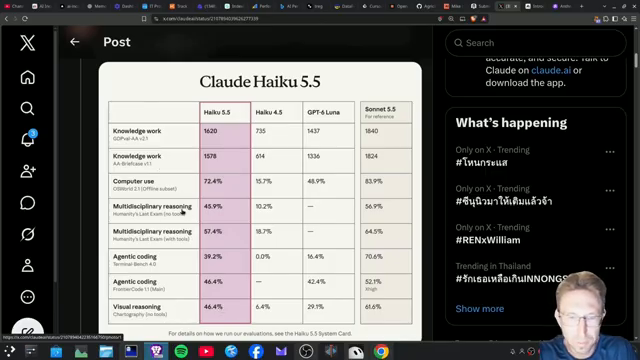
Across knowledge work, computer use, multidisciplinary reasoning, agentic coding and visual reasoning, Haiku 5.5 beats Haiku 4.5 by a wide margin and also beats GPT6 Luna, OpenAI’s lightest model. As you’d expect, it doesn’t reach Sonnet 5.5. I show this on screen in the video.
Knowledge work
On GDPval it scores almost double Haiku 4.5, and about double on AA Briefcase as well. On GDPval it’s close to GPT6 Luna at lower effort and well ahead on max effort, though max costs much more.
Computer use
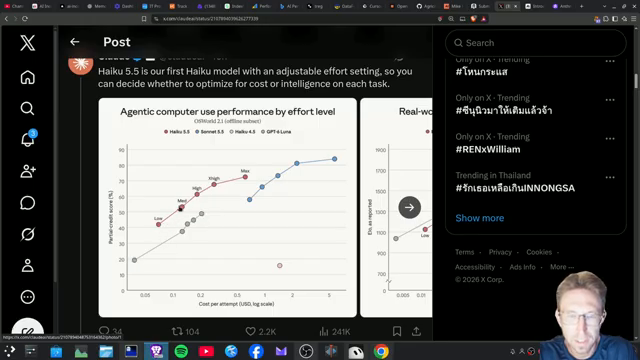
It scores 72% compared with only 15% for Haiku 4.5, well ahead of GPT6 Luna and just behind Sonnet 5.5. On OSWorld at extra-high effort it scores about 67% for about 28 cents. GPT6 Luna scores about 44%, and Sonnet 5.5 scores about 81% at nearly ten times the cost.
Agentic coding
Haiku 4.5 scored 0% on this benchmark. Haiku 5.5 scores 39%, compared with 16% for GPT6 Luna and 70% for Sonnet 5.5. On Frontier Code 1.1 it scores 46%, compared with 42% for GPT6 Luna and 52% for Sonnet 5.5 on extra-high. Haiku 4.5 wasn’t listed.
Haiku 5.5 pricing
- Input: $0.10 per million tokens, about 10x cheaper than Haiku 4.5 ($1) and 20x cheaper than Sonnet 5.5 ($2).
- Output: $0.50 per million tokens, about 10x cheaper than Haiku 4.5 and 20x cheaper than Sonnet 5.5 ($10).
Anthropic has also halved the price of Claude 5.5 cache reads, which it says makes Sonnet 5.5 about 20% cheaper on most agentic work. Max, Ultra and Team plans include monthly API credits for building agents and apps on the Claude platform. Official docs list $100 a month on Max, $200 on Ultra, and up to $500 pooled on Team. Those credits apply to the Claude API in the Console, not to Claude Code.
What the price difference looks like in practice
Here’s a simple example using the list prices. Take a job that uses 1 million input tokens and 200,000 output tokens, which is typical for a batch of support replies or a run of document extraction.
- Haiku 5.5: $0.10 input + $0.10 output = about $0.20.
- Haiku 4.5: $1.00 input + $1.00 output = about $2.00.
- Sonnet 5.5: $2.00 input + $2.00 output = about $4.00.
- Opus 5.5: $4.00 input + $4.00 output = about $8.00.
The same workload costs 20 times more on Sonnet and 40 times more on Opus. That’s why model choice matters more than prompt tweaks once you’re running agents at volume. This example ignores cache discounts and differences in how many tokens each model uses.
Safety and availability
Anthropic reports big improvements over Haiku 4.5 in its alignment evaluations, with far fewer cases of misaligned behaviour and less willingness to help with misuse. Its cybersecurity safeguards are stricter than Haiku 4.5’s but looser than those on Anthropic’s more capable recent models, because it’s a less capable model.
It’s available on the Claude platform as well as Amazon Web Services, Google Cloud and Microsoft Azure.
How to get started with Haiku 5.5
- On the Claude platform, choose Haiku 5.5 as the model for your app or agent.
- On AWS, Google Cloud or Azure, enable it in your provider’s model catalogue.
- Begin with one high-volume task, such as support triage, and compare quality and cost with your current model.
- In multi-agent coding setups, give Haiku the sub-agent jobs and keep Sonnet or Opus as the lead.
Haiku, Sonnet or Opus: which should you use?
Based on the published numbers across the Claude 5.5 family, here’s how I’d decide:
- Haiku 5.5 ($0.10/$0.50): high-volume, repetitive or speed-sensitive work, support bots, browser tasks and coding sub-agents.
- Sonnet 5.5 ($2/$10): everyday coding, first drafts and most agentic work. It’s close to Opus on many benchmarks.
- Opus 5.5 ($4/$20): the hardest reasoning and frontier coding problems, where it still leads.
The next thing I want to build is a router that automatically sends each task to the right model, so I’m not paying Opus prices for Haiku-level work.
Common mistakes to avoid
- Using a big model for small jobs. Simple, repetitive tasks rarely need Sonnet or Opus.
- Expecting Sonnet-level coding. At 39% on agentic coding, Haiku is better as a sub-agent than as your main coder.
- Defaulting to max effort. On some tests max effort multiplies the cost for a modest gain.
- Ignoring cache pricing. Cheaper cache reads can cut agent costs significantly.
- Sending huge contexts. Haiku is best value on tasks under 100,000 tokens.
Want help building this for your own business?
The video shows what’s possible. Inside AI Income Lab, the paid community from AI Automation Station, you get step-by-step courses, reusable templates, and a place to ask questions while you build. The courses walk you through builds like this one step by step. Over 2,900 members are already building with it, from $29 a month, and you can cancel anytime.
FAQ
How much does Claude Haiku 5.5 cost?
$0.10 per million input tokens and $0.50 per million output tokens, about 10x cheaper than Haiku 4.5.
Is Haiku 5.5 better than GPT6 Luna?
On the published benchmarks it beats GPT6 Luna on computer use, agentic coding and most other tests, and is close on GDPval at lower effort.
Can Haiku 5.5 write code?
Yes. It scores 39% on agentic coding and 46% on Frontier Code 1.1. It works best as a sub-agent for Sonnet or Opus.
Where can I use Haiku 5.5?
On the Claude platform, Amazon Web Services, Google Cloud and Microsoft Azure.
When should I choose Sonnet 5.5 instead?
For everyday coding and complex agentic work, where its much higher scores are worth the extra cost.
Conclusion
Claude Haiku 5.5 is a big leap for small models: much stronger than Haiku 4.5 at about a tenth of the price, and ahead of GPT6 Luna on most tests. Use it for high-volume and speed-sensitive work, pair it with Sonnet or Opus for coding, and route tasks by difficulty to keep costs down.
If you’d rather not figure this out alone, AI Automation Station has a paid community for it: AI Income Lab. It’s where the courses, templates and help that go with these builds live, with 2,900+ members, from $29 a month, cancel anytime.

Leave a Reply